
Coffee Cart vs Coffee Station: What Planners Should Know
Most venues will offer you a coffee station. It is the default, it is cheap, and for some events it is genuinely the right call.
Here is when it is not.
What each one actually is
A coffee station is a table. Urns or pump pots, a stack of cups, cream, sugar, stirrers, and a trash can. Nobody staffs it. Guests serve themselves.
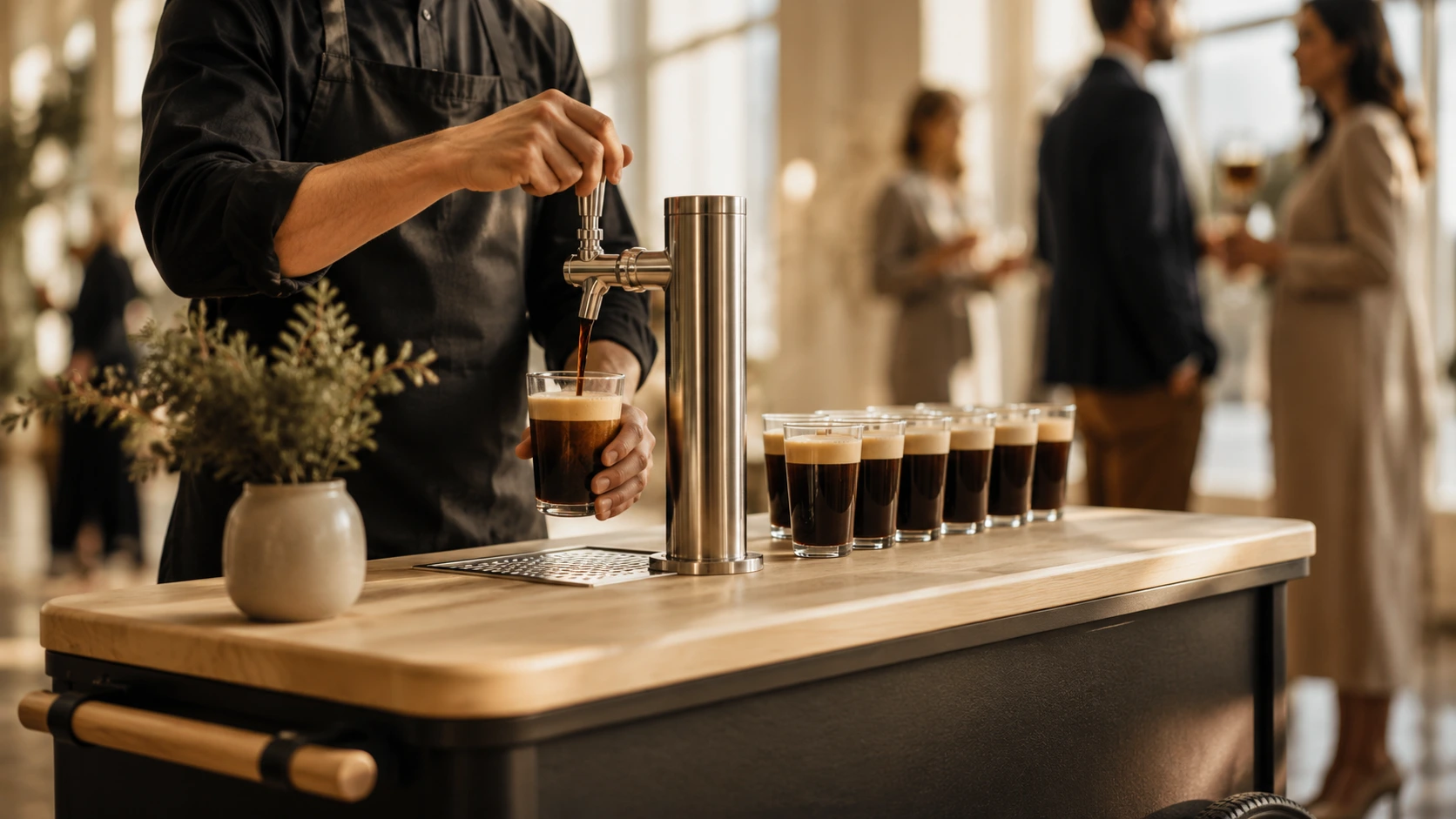
A coffee cart is a staffed unit with a person pouring. For us that means a nitro tap system, a keg, and a barista who works your full service window.
Throughput
This is where the difference shows up first, and it is not the number most people expect.
A station has no theoretical limit but a real one. Guests bottleneck at the pour spout, then at the cream, then at the sugar. Every person occupies the table for 30 to 60 seconds because they are assembling a drink, not receiving one.
A cart pours in seconds because the drink arrives finished. Our carts run about [X] drinks per hour, sustained.
The counterintuitive result: a staffed line usually moves faster than a self serve table, because self serve is not one line, it is three.
Temperature
An urn loses heat. Within an hour the coffee is lukewarm, and by hour two guests are quietly not drinking it.
A nitro keg holds cold for the entire window. Hour four pours the same as hour one. In Central Florida this is not a nice to have. An outdoor hot coffee station in July is a table nobody visits.
Staffing and supervision
A station needs someone from your team refilling urns, restocking cups, wiping spills, and emptying trash. That person exists whether you planned for them or not, and it is usually a venue staffer pulled off something else.
A cart brings its own person. Nothing on your team touches it.
Footprint
A station needs the table plus back stock, which people forget. Boxes of cups, backup urns, and a cream cooler have to live somewhere, usually behind or beside the table.
Our cart takes [X] feet by [X] feet total, with everything inside it.
What guests actually experience
A station is functional. Nobody photographs an urn.
A cart is a thing people walk toward. The nitro pour is visual, guests stop to watch it, and it gives them somewhere to stand and talk. At a pop up or product launch that traffic is the entire point.
Side by side
| Staffed cart | Self serve station | |
|---|---|---|
| Staffing | Included | Your team or venue |
| Throughput | [X] per hour, steady | Bottlenecks at three points |
| Temperature | Holds full window | Drops within an hour |
| Footprint | [X] x [X] ft, self contained | Table plus back stock |
| Dairy and sugar setup | Not needed | Required |
| Guest experience | Visual, social | Functional |
| Waste | Sealed keg | Poured out pots |
| Cost | Higher | Lower |
When a station is the right call
We will say this plainly, because it is true.
If your event is under 20 people, runs less than an hour, or is an internal team meeting where nobody cares about presentation, a station is fine. Spending on a cart there is spending for no return.
When a cart wins
Guest count over [X]. Service window over two hours. Outdoors in Florida. Alcohol free. Anywhere the coffee is part of the guest experience rather than a utility.
Weddings, conferences, launches, and client facing corporate events all sit in that column. Every one of them is an event where a lukewarm urn is a small failure that people notice.
The short answer
A station is cheaper and does the minimum. A cart costs more and removes the work, the temperature problem, the second station, and the line.
Pick based on whether coffee is a utility at your event or part of it.
Not sure which fits your event? Tell us the guest count and the window. See nitro coffee catering.
Ready to give your guests something to remember?
Tell us about your event and we’ll bring the cart. Serving weddings, corporate events, parties, and markets across Central Florida.
Get Pricing